




Look, if you’re not paying attention to this matchup, you’re missing out on one of the most intriguing clashes in modern tennis. Seriously.
Alex de Minaur against Hubert Hurkacz isn’t just another tour match. It’s a full-on collision between two completely different philosophies of how tennis should be played. One guy runs down everything like his life depends on it. The other bomb 130 mph serves and asks you to deal with it.
And honestly? That’s what makes this thing so damn watchable.
Two Guys, Two Completely Different Paths
The Demon from Down Under
Alex de Minaur didn’t become one of the best players in the world because he has the biggest weapons. He got there because he refuses to lose.
Born in Sydney back in February 1999, this guy has turned sheer willpower into a top-10 ranking. And if you’ve watched him play, you know exactly what I’m talking about. He’s the player who makes you think, “There’s no way he’s getting to that ball,” and then somehow, impossibly, he does. Every. Single. Time.
His career résumé speaks for itself:
- Cracked the top 10 in 2024 and hasn’t looked back
- Multiple ATP titles on different surfaces
- Deep runs at both the Australian and US Opens
- Led Australia to United Cup glory
But here’s the thing about De Minaur that numbers don’t capture: he’s gotten better every single year. Not in bursts. Not in flashes. Steady, relentless improvement. Three years ago, he was a promising grinder hovering around 25th in the world. Now? He’s mixing it up with the best and winning more than he loses.
His game has evolved, too. That forehand carries more pop these days. He’s taking the ball earlier, dictating more often. He’s still the ultimate counterpuncher, but now he’s punching back harder.
The Polish Giant with the Rocket Arm
Hubert Hurkacz is a completely different animal.
Standing at 6’5″ with a serve that regularly touches 130+ mph, the Polish number one doesn’t need to run down every ball. He’d rather you never return it in the first place.
Born in February 1997, Hurkacz has put together a career that includes moments of genuine brilliance:
- Wimbledon semifinal run in 2021 that turned heads worldwide
- Miami Open champion (beating some big names along the way)
- Consistent top-15 presence for multiple seasons
- One of the most feared servers on tour
When Hurkacz is feeling it, he’s borderline unplayable. That sets up everything. He can go wide, jam you down the T, or kick it up into your shoulder. And if you do manage to get it back? Good luck with that heavy forehand coming your way.
But here’s where it gets interesting. Unlike De Minaur, Hurkacz has had his share of inconsistent stretches. Some weeks, he looks like a future Grand Slam champion. Other weeks, you’re left scratching your head, wondering where that guy went.
That unpredictability is exactly what makes this matchup so hard to call.
The Head-to-Head: What History Tells Us
These two have met several times now, and if you’re looking for a clear pattern, you won’t find one.
The record sits close. Hurkacz holds a slight edge at roughly 3-2, but that doesn’t tell the whole story. Their matches have been absolute wars. We’re talking extended sets, tiebreaks, and momentum swings that would give anyone watching anxiety.
A few standouts from their previous meetings:
That 2023 three-setter was pure entertainment. Both guys landed heavy shots, both had their moments of brilliance, and it came down to who blinked first in the crucial moments.
The 2024 Masters meeting showed a different De Minaur. He’d clearly studied the tape, adjusted his return position, and made Hurkacz work harder for every service game. It felt like a turning point in the rivalry.
Earlier encounters saw Hurkacz dominate with his serve, barely facing any pressure on his own delivery.
What’s clear is that these matches rarely produce blowouts. Expect drama. Expect tiebreaks. Expect at least one moment where you’re on the edge of your seat.
How They Stack Up: A Style Breakdown
This is where it gets really fun to analyze.
De Minaur’s Toolkit
Forget power rankings and big serves. De Minaur wins by making you hit one more ball than you want to.
His movement is genuinely elite; we’re talking world-class, arguably best-in-generation territory. He slides, he stretches, he somehow gets racket on balls that have no business coming back. And he does it for three hours if that’s what it takes.
His serve won’t scare anyone. Mid-120s, lots of placement, low risk. But his return game? That’s where he hurts you. Against big servers, he backs up about three feet further than most players. Sounds simple, but it gives him just enough reaction time to neutralize the biggest weapons.
Off the ground, that cross-court backhand is money. He’ll stay patient, work the point, wait for the opening, then crack that backhand into the corner. Over and over until you make a mistake.
The guy simply doesn’t give you free points. Ever.
Hurkacz’s Arsenal
Hurkacz’s game plan is simpler: hit big, finish fast, move on to the next game.
That serves as the whole foundation. When he’s landing 65% or more of first serves, he’s incredibly difficult to break. The height, the speed, the angles, it’s a lot to handle, especially if he’s feeling confident.
He’s also surprisingly good at the net. Not enough players use serve-and-volley tactics anymore, but Hurkacz will mix it in, especially on faster surfaces. His volleys are clean, his approaches are aggressive, and he can end points before they even start.
The forehand is a beast when he’s dialed in. Heavy, penetrating, and he can go anywhere with it.
But, and this is important, extended rallies aren’t his friend. When De Minaur drags him into those 15-shot baseline battles, Hurkacz starts to look uncomfortable. His movement is fine for a guy his size, but “fine” isn’t going to cut it against someone who covers court like De Minaur.
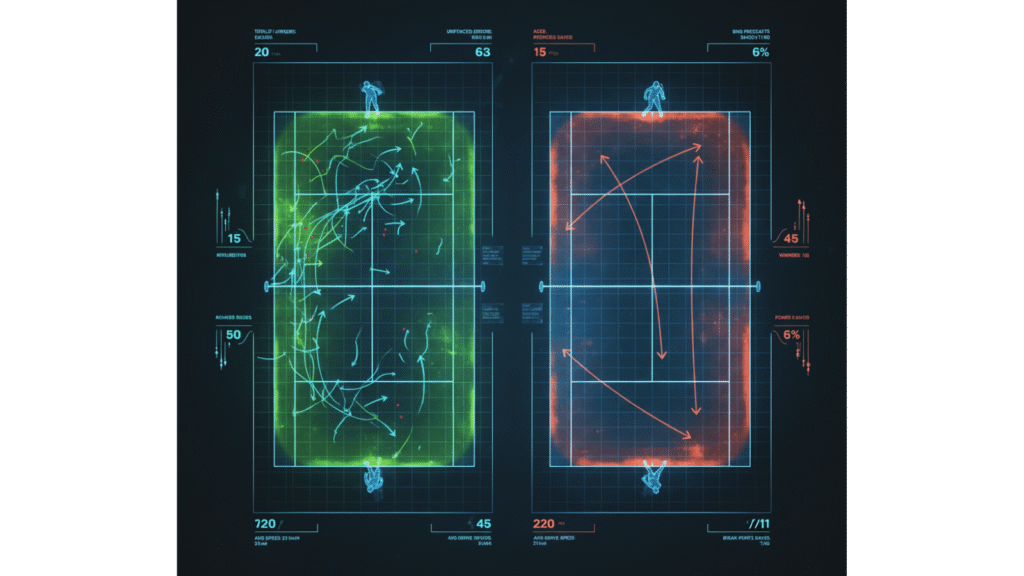
The Numbers Worth Knowing
Let’s talk stats, because they paint an interesting picture.
First Serve Percentage:
- De Minaur: Around 64% (reliable, not spectacular)
- Hurkacz: Around 68% (with way more aces)
Aces Per Match:
- De Minaur: Maybe 4-5 if he’s lucky
- Hurkacz: 10-12 on a typical day, more when he’s locked in
Break Point Conversion:
- De Minaur: Roughly 42% (elite level)
- Hurkacz: Roughly 38% (solid but less clinical)
Here’s the key stat, though: De Minaur saves break points at a significantly higher rate. That mental toughness in tight moments? It shows up in the data.
Winner-to-error ratios are revealing, too. Hurkacz generates more outright winners but also sprays more balls. De Minaur won’t hit as many jaw-dropping shots, but his error count stays almost unnaturally low. It’s the classic high-risk versus high-consistency debate, and neither approach is wrong, just different.
What Decides This Match?
Alright, prediction time. But first, let me break down the key battlegrounds.
If Hurkacz serves at 65%+ and piles up aces, He takes control. De Minaur can return anything, but even he can’t return serves he never sees. If Hurkacz is on fire from the service line, this could be a straight set.
If De Minaur gets return games going: Watch out. The longer he stays in points, the more errors creep into Hurkacz’s game. If De Minaur can create four or five break opportunities, he’s converting at least one or two.
The tiebreak factor: Their previous matches suggest we’re getting at least one tiebreak. Maybe two. Who wants it more in those moments? That’s often the decider.
Physical conditioning: If this goes three sets and extends past two hours, advantage De Minaur. His engine doesn’t quit. Hurkacz can definitely hang, but the Australian is built for five-set wars.
My Take
Gun to my head? I’m leaning De Minaur in three tight sets. Something like 7-6, 4-6, 6-4.
His form has been more consistent lately. His tactical approach against big servers has clearly improved. And in the moments that matter, he just seems to find a way.
But honestly, this could flip on two or three points. If Hurkacz hits one extra ace in a tiebreak, if one De Minaur passing shot clips the tape instead of landing in, the whole outcome changes.
That’s what makes this matchup so compelling. Neither guy is a heavy favorite. Both can win. Both have legitimate paths to victory.
What This Match Means
Beyond the pure entertainment value, real stakes exist here.
For De Minaur, a win cements his top-10 credentials. It proves that his rise wasn’t a fluke, that he belongs among the elite, that he can beat big-serving opponents when it counts.
For Hurkacz, victory could spark a push back toward his career-best ranking. He’s been floating just outside the top 10 recently, and a statement win here could be the momentum shift he needs heading into the business end of the season.
Grand Slam seeding implications loom too. Both guys want high seeds for the majors. Every win matters in that race.
Conclusion
This isn’t just another tennis match. It’s a chess match between two players who see the game completely differently.
De Minaur wants long rallies, tight service games, and tiebreaks decided by sheer willpower.
Hurkacz wants quick points, free aces, and a scoreboard that never gives his opponent hope.
Someone’s vision wins. Someone doesn’t.
And that tension, that uncertainty, that pure sporting drama, that’s why we watch.
Set your reminders. Clear your schedule. This one’s going to be worth every minute.
Read more: news